I. The 4000W Power Race: Why Must Hair Removal Devices Pursue Ultra-High Power?
In the photoelectric segment of the medical aesthetics category, the handpiece laser power of laser hair removal devices has escalated rapidly from an early 600W and 1200W to 2000W and 3000W, and the total laser power of today's flagship models has even been pushed as high as 4000W. This pursuit of power stems from the fundamental medical logic of selective photothermolysis:
1. Strict limits imposed by tissue thermal relaxation time (TRT): 808nm falls in the near-infrared range and is efficiently absorbed by the melanin in hair follicles. The thermal relaxation time of human follicular tissue generally ranges from 10 ms to 100 ms. The laser must deliver sufficient energy into the target tissue within an extremely short window (an ultra-narrow pulse width), raising the follicle to 65°C–75°C for denaturation and necrosis. If power is insufficient and the pulse width too long, heat diffuses into the dermis and epidermis, reaching the nerve endings to cause pronounced burning pain and significantly raising the risk of burns.
2. The hard requirement for large spots and ultra-fast gliding: To improve clinical throughput and accommodate large-area hair removal, the handpieces of modern laser hair removal machines commonly use an emission aperture of 12×20 mm or even larger, gliding at a high frequency of 10 Hz. As the spot area multiplies, maintaining the effective energy density (J/cm²) needed to destroy deep follicles requires a proportional increase in the light source's total laser output power, which makes 3000W–4000W ultra-high power the direction the industry demands.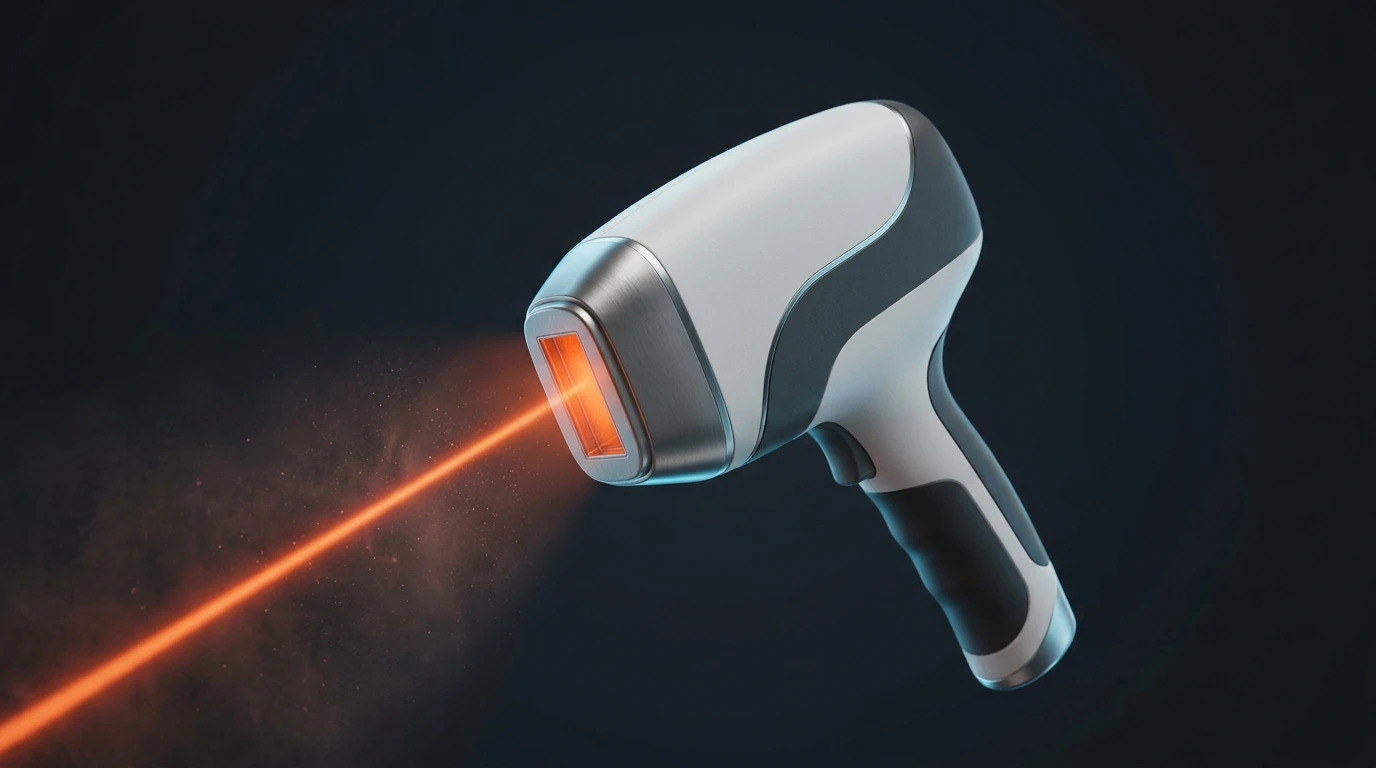
II. Engineering Bottlenecks of Conventional Approaches: The "Three Fatal Flaws" of 50W/100W Bar Stacking
Because the manufacturing barrier for semiconductor laser chips is extremely high, the industry's mainstream bars were long confined to 50W and 100W. To reach a total power of 3000W–4000W, system manufacturers had no choice but to adopt "mechanical stacking," which brings severe engineering side effects:
l The handpiece degenerates into a "slab of iron," placing a heavy burden on the operator: With 100W bars, a 4000W output requires stacking 40 bars inside the handpiece; with 50W bars, the stack count is even larger. Counting the heat sinks of the macro-channel structure, the electrode leads, and the water nozzles, the handpiece's net weight often exceeds 800 g and even approaches 1 kg, making hand fatigue highly likely for aesthetic operators over hours of continuous work.
l Sharply increased water-path resistance and loss of thermal control: Roughly half of the electrical-to-optical conversion in a semiconductor laser becomes waste heat. Concentrating dozens of bars inside a cramped handpiece requires multiple layers of water-cooling channels, making the cooling circuit extremely complex and prone to surging flow resistance, uneven water distribution, and scaling blockage. Local overheating directly causes severe thermal drift of the lasing wavelength (typically 0.28–0.30 nm/°C), shifting the center wavelength away from melanin's optimal absorption band and impairing treatment efficacy.
l Series "bucket effect" and single-point burnout: Stacked handpieces typically use a series electrical design. If even one of the dozens of bars suffers breakdown, short-circuiting, or burnout under prolonged high-current stress, the entire optical handpiece must be scrapped or returned to the factory for repair, imposing severe cost pressure on end users.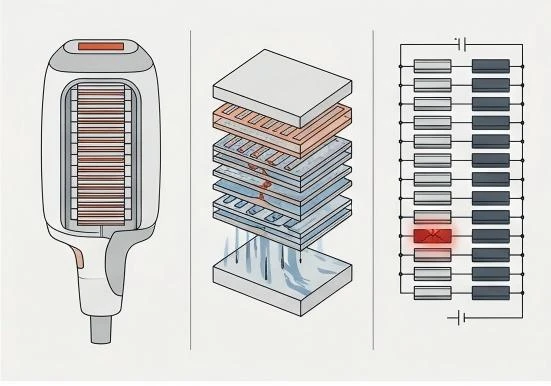
III. Why Haven't 200W Bars Become the Market Mainstay?
Faced with the 100W stacking bottleneck, the industry once attempted to mass-produce 200W bars. However, under the continuous stress of high-frequency pulsing and high current, the 200W products of many manufacturers proved unstable:
l Catastrophic optical damage (COMD): At extremely high optical power densities, the chip's cleaved facet is highly susceptible to instantaneous melting and burnout caused by local heat absorption and an optical absorption avalanche.
l Smile effect and thermal stress fatigue: The thermal expansion mismatch caused by high-power operation readily produces lateral microscopic warping of the chip (the smile effect), leading to beam distortion, uneven spot energy distribution, and fatigue cracking of the solder joint.
l System manufacturers are therefore caught in a dilemma: continuing with 100W stacking makes the handpiece too heavy and too hot, while switching to unstable 200W bars brings higher costs and a rising after-sales repair rate. The breakthrough for both lightweight systems and ultra-high power thus comes down to one fundamental question: can a single bar's output cross the 300W threshold while maintaining extremely high stability?
IV. Comparison of Laser Light Source Solutions for Aesthetic Hair Removal Handpieces
| Comparison Dimension | Conventional 100W Bar Stacking | Common 200W Bar Solution | Next-Generation Single-Bar 300W Solution (GK Semiconductor) |
| Number of bars required to achieve 3000W–4000W | 30–40 pcs (extremely bulky) | 15–20 pcs | 10–14 pcs (streamlined structure) |
| Handpiece net weight and volume | Net weight over 800 g; extremely unwieldy to operate | Moderate volume; cooling structure still fairly complex | Handpiece volume cut by more than 50%; light and portable |
| Complexity of water-cooling channels | Very many channel layers; high water resistance and prone to scaling | Moderate water resistance; demanding local heat-sink requirements | Water path greatly simplified; uniform and stable heat dissipation |
| Chip facet stability (COMD) | Relatively mature, but cannot satisfy high-power, lightweight requirements | Many manufacturers' processes are immature; COMD occurs easily | Proprietary facet passivation; validated through long-term customer acceptance |
| After-sales repair and maintenance cost | Many series nodes; high risk of single-point failure | High chip failure rate; heavy warranty pressure on the system | High consistency and ultra-long lifetime; extremely low repair rate |